
Part of the Geospatial Growth Series
Let’s talk about the client you never quite expected.
You know the one. They came in through a side door, maybe a chance introduction at a conference, a referral from someone you hadn’t spoken to in years, or a cold call that happened to land on the right desk on the right day. They turned out to be everything you’d ever want: good margins, clear briefs, fast decisions, steady repeat work. They paid on time. They trusted your expertise. They probably even sent a colleague your way.
And then… you put it all down to luck.
Most survey firm owners do. Because when something good happens without a plan behind it, “luck” feels like the honest explanation. But if you believe it was luck, you’ll spend the next five years waiting for lightning to strike twice, instead of building yourself a rod.
This article is about why your best client wasn’t a fluke. It was a signal. And once you learn to read it, you can use it to find ten more just like them.
“My Fear Is Not Being Able to Deliver If We Grow More”
During a recent GMA webinar all about the Commercial Skills Gap, one survey firm owner said something out loud that most owners only think privately:
“My fear is not being able to deliver on time if we grow much more, so I avoid marketing.”
It triggered a flood of recognition. Another owner noted:
“We know we are not currently scalable. Sole proprietorship. Working from a home office. No raises in four years. Need marketing, staff and office expansion. All of which is terrifying.”
This is the real reason so many survey businesses don’t pursue better clients deliberately. It’s not that they don’t want them. It’s that growth feels dangerous when the business is already stretched – when delivery depends on the owner being present for every job, when the thought of more work arriving before the team is ready is genuinely frightening.
So they stay with what they know.
They rely on referrals. They take whatever work comes in. And when a genuinely brilliant client lands unexpectedly, one with good margins, clear briefs and zero price-haggling, they assume it was just a lucky break.
It wasn’t. And understanding that distinction is the first step to changing EVERYTHING.
The Dunkin’ Donuts Problem
I often tell a story that will be immediately familiar to many survey firm owners.
A Geospatial Marketing Academy customer had landed a significant commercial contract with a well-known US fast-food chain. The work was scoped clearly, paid well and the client understood the value of what they were buying. A clean, profitable engagement the firm genuinely enjoyed.
When asked about it, the owner said something revealing: “It was a one-off. We just got lucky.”
They had no plan to replicate it. No idea what made that client different. No strategy for finding another like them. The experience was filed under “fortunate coincidence” rather than commercial insight.
This is one of the most common and costly thinking errors by a survey business. Most survey firm owners came up through technical excellence, not commercial strategy. When business development has always been driven by word of mouth and reputation, an outlier win genuinely does feel random.
But it wasn’t random. That profitable client had the exact profile of characteristics, behaviours, decision-making patterns and budget structures that made them a perfect fit.
And that profile can be reverse-engineered, documented and used to find more of them – deliberately.
What the Data Says About Your Best Clients
The Pareto Principle holds consistently in professional services: roughly 20% of your clients generate around 80% of your revenue. The top 4% of clients can account for 64% of total sales as the rule compounds. In a firm with 30 active clients, 6 to 8 of them are carrying the vast majority of the financial weight, and one of those may well be your Dunkin’ Donuts equivalent.
The geospatial and surveying industry is growing at a 7.38% CAGR, projected to reach USD 58.61 billion globally by 2032. That growth creates real commercial opportunity, but only for the firms positioned to capture a deliberate share of it. The firms winning that share aren’t necessarily the most technically gifted. They’re the ones who know exactly who their best clients are, why those clients chose them and how to find more of them.
Why Referrals Have a Ceiling
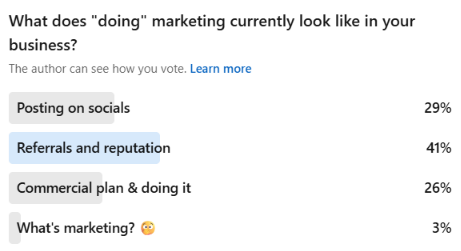
The survey industry runs on referrals, and referrals are genuinely powerful:
- 84% of B2B decision-makers start the buying process with a referral
- Referred leads convert 30-70% better than other channels
- Referred clients have a 16% higher lifetime value
(More referral biz stats here)
But there is a ceiling. You have zero control over who is referred, when they arrive, or whether their profile matches your most profitable clients. When you’re anxious about capacity (as nearly everyone I speak to in the Geospatial industry is) you end up taking whatever arrives because you can’t afford to be selective. That creates the vicious cycle: poorly-fitting work consumes more time and delivers less margin, leaving no headroom to be more deliberate.
Only 20% of satisfied clients will voluntarily refer others, compared to 98% of highly engaged clients who do. And 57-70% of the buying decision is already complete before a prospect ever speaks to a supplier.
If your firm isn’t visible during that pre-buying research phase, you’re not in the conversation, regardless of how good your work is.
Word of mouth is a bonus. It is not a business development strategy..
What Is Commercial Capacity?
It’s a great question, and the answer sits at the heart of this entire article.
Commercial capacity is your firm’s ability to attract, win and retain the right work, not just any work. It’s the difference between a full diary and a profitable one. Between being busy and building a business.
Most survey firms have excellent technical capacity: skilled crews, quality equipment, solid delivery processes.
What’s almost entirely absent is commercial capacity, the ability to systematically identify, target and convert high-value clients.
Another webinar participant cut straight to it: “We’re licensed professionals, not hourly workers.” That is exactly the right belief.
But the follow-on question is, does your marketing communicate your value in a way your ideal clients will understand, or are you still competing on price because you haven’t built the commercial architecture to attract clients who believe it too.
Commercial capacity is built, not found. And it starts with understanding who your best clients are.
Step One: Reverse-Engineer Your Best Client (The Buyer Persona)
The first step to finding 10 more like your best client is understanding why that client was your best. I teach this in the Geospatial Marketing Academy as the Buyer Persona, a documented profile of your ideal client that goes far beyond ‘construction companies’ or ‘infrastructure developers’.
“When you’re selling to everyone, you’re selling to no one.”
A residential developer has vastly different needs from a municipality. And within each organisation, the person signing off on your proposal has their own priorities, pressure points and decision-making process.
A strong buyer persona answers:
- Who is making the decision? Their role, seniority and technical knowledge
- What problem are they actually solving? The business problem, not the technical one. What outcome are they accountable for?
- How do they buy? Where do they research suppliers? How long is their decision process?
- What makes them choose one firm over another? Speed, track record, specialism, responsiveness?
- What are their red flags? What would make them walk away or choose a competitor?
For your lucky client, the one who made you a fortune, answering these questions isn’t theoretical. You worked with them. You know what made the engagement run smoothly. The exercise is to write it down and turn a lived experience into a replicable framework.
The data on this is unambiguous: companies using documented buyer personas are 71% more likely to exceed revenue and lead goals. 93% of companies exceeding their lead and revenue targets segment their database by buyer persona. One MarketingSherpa study found implementing buyer personas drove a 171% increase in marketing-generated revenue.
You are not just describing a client or creating fun characters. You are building a targeting system.
The Pareto Audit: Start With What You Already Have
Before building a buyer persona from scratch, mine your existing client data. Take your last three years of completed projects. For each client, record total revenue, gross margin (not just revenue, time investment, payment behaviour, repeat and referral value and how enjoyable the engagement actually was.
Rank them – not just by revenue, but by profitability and ease combined. The client in the top tier is your starting point. Look for common characteristics across your top 20%: sector, company size, geography, project type, how they found you, what language they used in briefings, what they valued most.
This is the Ideal Client Profile (ICP) – a data-backed description of the clients most worth pursuing. The ICP describes the organisation; the buyer persona describes the individual within it who decides.
For most survey firm owners, this analysis produces an immediate realisation: the clients generating the most revenue are rarely the ones consuming the most time. The ones eating up your management hours are often contributing a fraction of the margin. That is a mismatch between who you’re attracting and who you should be targeting, and fixing it is how you scale more smoothly without overwhelming the business.
The Buyer’s Journey: How Clients Actually Find You
Once you know who your ideal client is, the next step is understanding how they buy. I teach the Customer Journey as a core GMA framework, and it starts with a reality check that most survey firm owners find genuinely surprising.
Chet Holmes’ Buyer Pyramid, drawn from thousands of live audience surveys, reveals the distribution of any market at any given moment:
- 3% are actively buying right now
- 6-7% are open to purchasing but not actively looking
- 20% know they have a need but aren’t thinking about it yet
- 30% aren’t thinking about it at all
- 40% have no interest
Every time a survey firm sends a pitch, enters a tender portal, or cold calls a prospect list, they are competing for that top 3%. Which means 97 out of every 100 contacts land in front of someone who was never going to buy today. This is not a failure of execution, it is a failure of strategy.
The firms winning the most profitable work are visible to the 6-7% who are open, and already trusted by the 20% who have a need but aren’t yet searching, so that by the time those buyers reach the 3% who are ready, those firms are already on the shortlist.
Buyers start with 5-8 vendors in mind and reduce to 3 or fewer before formal evaluation begins. Industry expertise is the highest deciding factor, above pricing, cost structure and product fit.
The practical implication: the work required to win your next best client starts six to twelve months before they contact you. Marketing that isn’t already in motion is already late.
Building the Sales Funnel That Replaces Luck
A sales funnel is a structured system for moving the right people from first awareness of your firm through to becoming clients, deliberately, predictably and repeatedly. The teaching in GMA 2.0 uses the funnel as core commercial architecture.
Top of funnel – Awareness:
Potential clients first encounter your firm through content that demonstrates expertise in a specific domain. A case study, a LinkedIn article addressing a sector-specific challenge, a YouTube video that explains a technical process in plain language. You are not selling. You are being found by people who have a problem you can solve.
Middle of funnel – Consideration:
A prospect is actively evaluating options. They have found your content, visited your website, perhaps attended a webinar. If your messaging speaks directly to your ideal client’s challenges, their sector, their role, their pressures, etc., you move from “one of several options” to “the obvious choice.” Marketing personas make websites 2-5 times more effective for targeted visitors. Personalised content increases customer engagement by six times when targeting cold leads.
Bottom of funnel – Decision:
The proposal stage. Most survey firms only exist here. Responding to briefs, competing on price, leaving outcomes to chance. Firms with a structured funnel arrive at this stage in a different position: the prospect has been educated, trust has been built and the relationship established before any formal contact. Businesses with a documented sales funnel generate 2.3 times more ROI than those without one.
The Five Characteristics of a Replicable Win
I hope you are now starting to see that your gold standard profitable client wasn’t random.
These five characteristics define the kind of engagement worth engineering:
They came to you with a problem, not a price. They wanted a firm that understood their sector and their required outcomes. That’s the buying behaviour your marketing should be built to attract.
They understood the value of what they were buying. They operated in a sector where precision has downstream consequences. They weren’t comparing you to the cheapest option on a portal.
Their decision-making was clear and efficient. A designated decision-maker, a defined budget, a clear brief, no endless procurement loops.
The scope aligned with your genuine strengths. Squarely in your core capability, delivered well, without the margin erosion of adapting to unfamiliar territory.
The relationship had long-term potential. Repeat contracts, scope expansion, or referrals into their network – more than one transaction.
What This Means for Your Survey Business
The ten biggest themes from people’s comments, concerns and questions in the recent GMA webinar were:
- Fear of growth
- Hiring uncertainty
- Owner overload
- Delegation struggles
- Workflow systems
- Mentorship gaps
- Retention and culture
- Scaling without losing quality
- Balancing technology and people
- Professional value and pricing
Every single one is a downstream symptom of the same upstream problem: firms are attracting the wrong work, from the wrong clients, in a reactive rather than deliberate way.
When you’re chasing every job that comes in, you can’t be selective about your team. When you’re relying on referrals, you can’t predict seasonality. When you’re competing on price, you can’t raise salaries. When you have no clarity on your ideal client, you can’t build the systems to serve them well.
Build the commercial foundation first. Know your best client. Build the system to find more of them. When the work coming in is consistently well-matched to your capability, everything else, hiring, delegation, capacity, culture, becomes a solvable problem instead of a permanent crisis.
Stewart Ward, a land surveyor in Idaho, applied exactly this framework through GMA 2.0. Revenue approximately tripled. But the more telling shift was qualitative: clients started calling saying “you’re my guy, just take care of it. We don’t even need a price first.” Christopher Juliano, a licensed land surveyor from Connecticut, saw increased job volume, better prospects and revenue growth within six months of joining the programme.
Neither story is about luck. Both are about applying commercial architecture (buyer persona, customer journey, sales funnel) to a business that already had excellent technical foundations.
Three Questions to Start With Today
Who is your single most profitable client of the past three years, and what five characteristics do they share with any other top-tier clients you’ve worked with?
- What problem did they have that you solved, and how would they have described it in their own language, before they knew the technical solution?
- If that client referred a colleague tomorrow, what would that colleague see when they googled your firm, checked your LinkedIn, or visited your website?
The answers are the beginning of a buyer persona, an ICP and a content strategy – all at once. Your lucky client left you a blueprint. Use it.
Elaine Ball is the founder of the Geospatial Marketing Academy (GMA) the only marketing and sales programme built specifically for survey firms and geospatial businesses.
The GMA 2.0 nine-phase programme takes survey firm owners from commercial invisibility to a fully operational marketing system, with buyer personas, sales funnels, customer journey mapping and content strategy built for the geospatial industry.
Learn more at geospatialmarketingacademy.com
Geospatial Businesses Marketing FAQs
Q: How do I start building a buyer persona for my survey business?
Start with your best existing clients. Look at your most profitable engagements from the past two to three years and identify the common characteristics – sector, company size, decision-maker role, the type of problem they brought you, how they found you and what they valued most. Build a one-page profile from those patterns. Give the persona a name, a role and a set of real challenges.
Q: What’s the difference between a Buyer Persona and an Ideal Client Profile (ICP)?
The ICP describes the organisation you most want to work with – its industry, size, geography, budget range and structural characteristics. The buyer persona describes the individual within that organisation who makes or influences the buying decision – their role, goals, pressures and behaviours. You need both. The ICP tells you where to look; the buyer persona tells you what to say when you get there.
Q: We rely entirely on referrals and it’s working fine – why change?
Referrals are a sign of excellent work, and they’re genuinely valuable as a lead source. But they have two structural limitations. First, you have no control over who is referred or whether that person matches your most profitable client profile. Second, referral volume is almost entirely outside your control, meaning your pipeline is exposed to factors you can’t influence. 57–70% of the buying decision is already made before a prospect contacts you. If your firm isn’t visible during that research phase, you’re not on the list when the referral happens to ask.
Q: I’m worried that more marketing means more work I can’t deliver. How do I handle capacity?
This is one of the most common concerns raised by survey firm owners, and it’s worth reframing. Better marketing doesn’t necessarily mean more volume, it means better-fit work. When you attract clients who match your ideal profile, you spend less management time per project, encounter fewer scope disputes, experience fewer payment issues, and deliver more efficiently. Many firms find that replacing three difficult low-margin clients with one well-matched high-value client reduces operational strain while improving profitability. The goal is not a fuller diary, it is a more profitable and manageable one.
Q: What does a sales funnel actually look like for a survey firm?
At its simplest: content that makes you visible to your ideal client (top of funnel), case studies and positioning that build trust while they’re evaluating options (middle of funnel), and a clear, professional proposal and follow-up process that converts interest into engagement (bottom of funnel). Most survey firms only exist at the bottom. Building the top and middle, through LinkedIn content, sector-specific case studies and targeted visibility in the places your ideal clients spend time, is what creates a predictable pipeline rather than a feast-or-famine cycle.
Q: How long does it take for this kind of commercial strategy to produce results?
Marketing in B2B professional services is a compound investment, not an instant return. The buyer journey in technical services averages 379 days from initial research to deal close. Most firms see meaningful pipeline impact within 6–12 months of consistent, strategic activity. The firms that abandon the approach at three months are the ones who conclude “marketing doesn’t work”, while the firms that stay the course are the ones adding their version of Stewart Ward’s third revenue tier. Start now: the six months you spend building this foundation are the same six months your ideal clients are already researching their next supplier.
Q: Do I need to hire a marketing person to do this?
No, and in most cases, hiring before you understand the system yourself is one of the most common and expensive mistakes survey firm owners make. As Elaine Ball teaches across her GMA programme: you cannot outsource a strategy you haven’t got. Whether you eventually hire internally, use an agency, or do it yourself, the commercial brain needs to stay in-house. The owner or director needs to understand who the ideal client is, what the funnel looks like, and what success looks like – so they can brief, evaluate and direct whoever is doing the execution.