
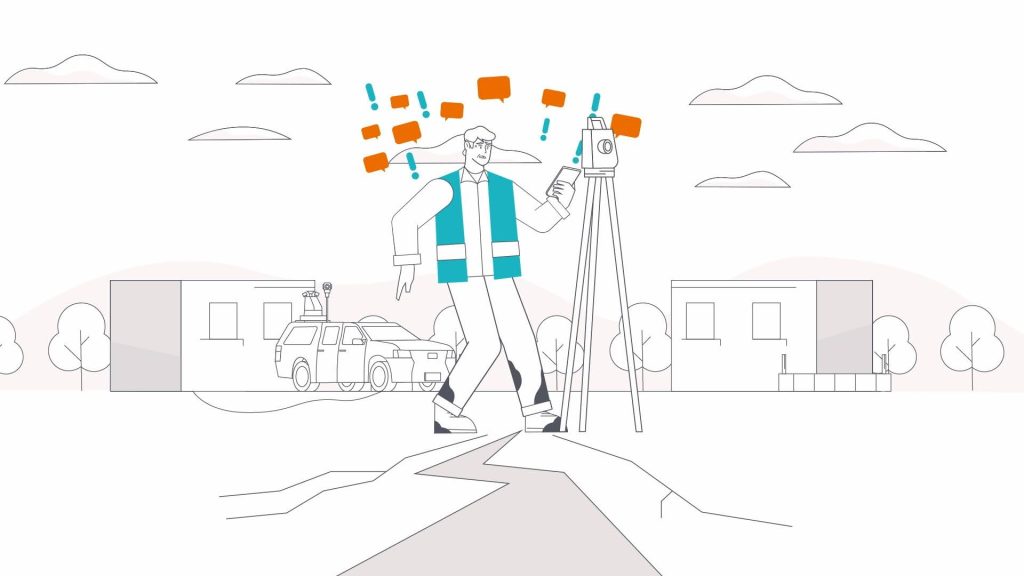
The Core Paradox
You can set up a total station on a windswept hillside, process a point cloud with sub-millimetre accuracy and deliver a topographic survey that engineers will build a hospital from.
But ask most survey firm owners how their next five clients will find them and you’ll get a shrug.
This is the paradox at the heart of the geospatial industry. Technically brilliant. Commercially invisible.
Surveyors avoid marketing because they think it’s expensive. The truth is the opposite: the real cost is never learning it properly. Marketing doesn’t leak money in one dramatic failure. It leaks quietly, across multiple places most surveyors never think to look and it compounds every single year you ignore it.
This document breaks down exactly where those leaks are, what they cost and what to do about them.
Why Survey Firms Underinvest in Marketing
The Market Has Shifted – Most Firms Haven’t Noticed.
The way buyers choose survey companies has fundamentally changed and most firms are still operating as if it’s 2010.
The data is stark:
- 57–70% of the buying decision is already complete before a prospect ever speaks to a supplier (CEB/Gartner research)
- 81% of buyers already have a preferred vendor in mind before they pick up the phone to talk to sales
And the picture has only sharpened since then. According to Forrester’s July 2025 report “B2B Marketing and Sales Are Too Late to Influence Decisive Buyers,” 92% of B2B buyers now start the purchasing process with at least one vendor already in mind. More striking still: 41% have a single preferred vendor selected before formal evaluation even begins and even among first-time buyers, 48% enter the process already favouring someone. Forrester’s conclusion is blunt: “Short-term lead generation alone cannot move the needle with decisive buyers. Vendors must focus on becoming the category leader in buyers’ minds before the Request For Price (RFP) ever lands.”
That’s not a pipeline problem. That’s a visibility and positioning problem and it starts long before any conversation happens.
On budgets, the benchmarks are clear. Gartner’s 2025 CMO Spend Survey puts the average marketing budget at 7.7% of revenue. The Deloitte/Duke CMO Survey puts it at 9.4%. For B2B services companies specifically, Forrester benchmarks it at 9%. Even the SBA recommends 7–8% for businesses under £5m revenue. Yet research from Pitney Bowes and the Centre for Economics and Business Research (CEBR) found that the average SME is only achieving 39% of planned marketing activity which means even firms that plan to market are quietly letting it slide.
Now ask yourself: what percentage of revenue does your survey firm allocate as a marketing budget?”
For most, the answer is close to zero. Not because they’ve made a strategic decision, but because they’ve never treated marketing as a commercial/revenue function at all.
This creates an enormous gap. Your buyers are making decisions about you or more accurately, without you – long before any conversation happens. If you’re not visible, not positioned and not demonstrating expertise during that critical early window (we call this the “pre-buying journey”), you’re not even in the game.
You’re waiting for a phone call that increasingly won’t come.
The 7 Hidden Costs
1. Your Own Billable Time
The mechanism: Survey firm owners and directors don’t hire marketers. They do it themselves – badly, inconsistently and between everything else. A LinkedIn post here. A panicked website update there. Chasing a tender response at 11pm.
The numbers: Most owners spend 3–5 unstructured hours per week on ad hoc marketing activity. That’s roughly 240 hours per year – six full working weeks.
And it’s not just marketing that gets squeezed. Pitney Bowes and CEBR research found that SME owners juggle an average of 7 different roles daily, and in a telling sign of where priorities end up, buying stationery ranks ahead of marketing for 35% versus 32% of SME owners. That same research found that while 77% of SME owners recognise marketing is important, a third rate their own marketing efforts under 5 out of 10 and 11% admit to doing none of the marketing they planned. It’s not apathy, it’s overwhelm.
What that time could have been spent on:
- Supervising crews and improving delivery quality
- Quoting better, higher-margin projects
- Building relationships with key clients and referral partners
- Improving operational efficiency
- Developing new service areas (monitoring, scanning, UAV)
The impact: You’re paying yourself senior rates to do junior marketing work you haven’t been trained for. It’s the most expensive marketing hire you could make and the least effective.
2. Quiet Underpricing
The mechanism: Most survey firms don’t struggle because they have no work. They struggle because they have the wrong work. Low-margin projects. Discounted quotes. Clients who chose you on price and will leave you on price.
This isn’t a sales problem. It’s a marketing problem. Marketing is what gives you pricing power. It determines how early you’re shortlisted, how much you need to discount to win and how much trust you carry into every proposal.
And there is something else going on here. As Highly Persuasive noted in March 2026: “In commodity markets, a low price signals efficiency. In professional services, engineering and specialist manufacturing, it signals something else entirely.” A low price in professional services doesn’t say “efficient” – it raises questions that credentials alone can’t answer.
Pricing is a brand signal.
And Beaton Research, with 20 years of professional services benchmarking behind them, consistently finds that firms known for exceptional service and strong positioning build greater trust and loyalty and clients are more accepting of premium pricing as a result. When the service feels transactional, even competitive fees can feel excessive, pushing firms deeper into the commodity trap.
The numbers: A firm turning over 150,000 that routinely discounts by just 10% is haemorrhaging 15,000 per year in margin it didn’t need to give away.
The impact: Without visible positioning and demonstrated expertise, you compete on price by default. Every discount is a marketing failure you can measure.
The Discount That Halves Your Profit – A Worked Example
Before the pricing leverage table, let’s go the other direction. Because most survey firm owners discount regularly without ever doing this calculation.
The scenario: You’ve quoted 25,000 for a topographic survey. The client pushes back. You knock 5% off to close the deal. Feels minor. Feels like good client management.
Here’s what actually happened:
Your original quote
| Project value | 25,000 |
| Cost to deliver (staff, fuel, equipment, software, overhead) | 22,500 |
| Your profit | 2,500 |
That’s a 10% operating margin – typical for a small survey firm carrying reasonable overhead.
After your 5% discount
| Project value | 23,750 |
| Cost to deliver | 22,500 (unchanged – wages don’t drop because you charged less) |
| Your profit | 1,250 |
The client saved 1,250.
You lost 1,250.
Your profit just halved. From a 5% discount.
Not a 5% reduction in profit. A 50% reduction. Because the 1,250 you gave away came entirely out of your pocket, your costs didn’t move a penny.
This is the number most survey firm owners have never sat down and calculated. They think of a discount as a small gesture. The maths says it’s anything but.
And it gets worse the thinner your margin is. Here’s how the same 5% discount plays out across the three margin scenarios:
| Your margin | Profit before discount | Profit after 5% discount | Profit lost |
| 10% | 2,500 | 1,250 | –50% |
| 15% | 3,750 | 2,500 | –33% |
| 20% | 5,000 | 3,750 | –25% |
At 10% margin, a 5% discount doesn’t cost you 5% of your profit. It costs you half of it.
The firms most likely to be discounting – the ones under the most price pressure, doing the most commodity work are also the ones for whom each discount is most destructive. That’s not bad luck. That’s the direct commercial consequence of unclear positioning.
The Pricing Leverage Table
Surveyors love numbers. So here’s the maths because most owners dramatically underestimate how much pricing power is worth.
The principle is simple: your costs are fixed. Staff wages, equipment, software, fuel. They don’t change whether you charge 10,000 or 10,500 for a job. So every extra pound / dollar you charge goes almost entirely to profit. That’s called operating leverage – and it means small price improvements have an outsized impact on the bottom line.
These figures are based on 100,000 revenue. Scale proportionally for your firm.
At 10% operating margin (Revenue: 100k | Costs: 90k | Base profit: 10k)
| Price Increase | New Revenue | New Profit | Profit Increase (£) | Profit Increase (%) |
| +1% | 101,000 | 11,000 | +1,000 | +10.0% |
| +5% | 105,000 | 15,000 | +5,000 | +50.0% |
| +10% | 110,000 | 20,000 | +10,000 | +100.0% |
At 15% operating margin (Revenue: 100k | Costs: 85k | Base profit: 15k)
| Price Increase | New Revenue | New Profit | Profit Increase (£) | Profit Increase (%) |
| +1% | 101,000 | 16,000 | +1,000 | +6.7% |
| +5% | 105,000 | 20,000 | +5,000 | +33.3% |
| +10% | 110,000 | 25,000 | +10,000 | +66.7% |
At 20% operating margin (Revenue: 100k | Costs: 80k | Base profit: 20k)
| Price Increase | New Revenue | New Profit | Profit Increase (£) | Profit Increase (%) |
| +1% | 101,000 | 21,000 | +1,000 | +5.0% |
| +5% | 105,000 | 25,000 | +5,000 | +25.0% |
| +10% | 110,000 | 30,000 | +10,000 | +50.0% |
The uncomfortable observation: A survey firm running at 10% margin that stops discounting by just 5% doesn’t increase profit by 5%. It increases profit by 50%. That’s the same effect as winning half as much work again – for free.
And note the direction of travel: the thinner your margin, the more powerful the pricing lever. Firms operating under price pressure are the ones with the most to gain from better positioning and the most to lose from continued discounting.
This is why
Bain & Company’s research on 1,700+ companies concluded that pricing is one of the most underleveraged commercial tools in business and why a 2025 analysis of nearly 2,000 publicly traded companies confirmed that a 1% improvement in price realisation yields a median 6.4% increase in operating profit across all industries.
3. The Feast-and-Famine Cycle
The mechanism: When you’re busy, marketing stops. When work dries up, you panic-market. This is the most common pattern in the industry and one of the most destructive. Most survey firm owners assume it’s just the nature of project-based work. It isn’t. It’s the predictable, documented result of not having a marketing system that runs independently of your delivery calendar.
Marketing has a lag. And in technical B2B services like surveying, that lag is longer than most owners realise.
Dreamdata’s analysis of real company data tracked every marketing interaction over 24 months and found the average B2B buyer journey runs to 192 days from first marketing touch to closed deal. Only 37% of revenue is influenced within the first quarter of starting marketing activity. It takes 6 months for just half of the revenue impact to materialise. A quarter of it won’t arrive within the year at all. Their conclusion: “The marketing strategy you’re executing in Q1 will hardly influence revenue in Q1. Most of it won’t even influence revenue in Q2.”
For technical services specifically, it’s longer still.
Dentsu’s 2024 research found the average time from a buyer starting their initial research to a deal closing in manufacturing and technical services is 379 days – over a year.
Focus Digital’s 2025 industry data puts the average sales cycle for construction firms at 134 days from first contact and that’s before the anonymous research phase that happens before any contact is made.
The practical implication is stark.
Treefrog (March 2026) put it plainly: “If your sales cycle is six months and you wait three months to strengthen your marketing, those three months do not disappear. They shift revenue further out. Pipeline does not build overnight and it does not catch up quickly. It shows up later – in softer quarters, in tighter targets.”
If you wait until you’re desperate for work, you’re not three months too late. You’re six to twelve months too late.
The cycle works like this:
- Busy period = no time for marketing = pipeline empties quietly in the background
- Quiet period = panic = desperate outreach, discounted quotes, accepting work that doesn’t fit
- Some work arrives = busy again = marketing stops again
- Repeat indefinitely
What AEC firms tell us
The most directly applicable evidence comes from architecture, engineering and construction (AEC) firms – the closest structural match to survey companies. Project-based, technically driven, labour-heavy, billing on milestones.
The data maps directly.
MGO CPA’s 2026 study of AEC firms found that labour accounts for 60–70% of all expenses in engineering firms. That means any cash gap hits payroll immediately – there’s no inventory to delay, no product to stop producing. Long project cycles mean billing milestones can lag months behind work already completed. One documented example: a 12-person engineering firm needed a £200,000 float just to cover payroll before its first client payment arrived. If that buffer doesn’t exist, the firm is already in crisis, even with a healthy order book.
Monograph’s 2026 Financial KPIs Report for AEC Firms sets the benchmark: healthy firms maintain 9–12 months of revenue under contract at all times. Below 6 months signals serious trouble. Below 3 months, it’s a crisis. When projects stall and they do, routinely – “revenue becomes unpredictable, leaving hiring plans, bonuses and equipment purchases hanging in limbo.” When month-over-month cash variance hits double digits, the firm is already in reactive mode. That’s the famine phase and it was triggered by decisions made during the feast.
The referral dependency trap
The underlying cause is almost always the same: over-reliance on referrals without a marketing system behind them. Success Academy UK’s 2026 research found that 70% of professional services owners rely primarily on referrals and the same 70% report inconsistent revenue. That correlation is not a coincidence.
Referrals feel reliable until they stop. And you cannot control when they stop.
According to the Federation of Small Businesses, cash flow problems are the number one concern for UK SME owners – year on year. And the project-based billing model in surveying makes this structurally worse than almost any other type of business.
One more number worth sitting with: only 20% of satisfied clients will refer others. But 98% of highly engaged clients do. The difference between satisfied and engaged is almost entirely down to relationship-building and visibility over time – which is, again, marketing.
The personal cost
This isn’t just a spreadsheet problem. Relay’s 2024 Cash Flow Compass surveyed business owners and found:
- 91% experience cash flow issues
- 62% say those issues caused real damage – missed opportunities, delayed projects, reduced staff hours
- 71% report negative personal impact: stress, anxiety, burnout, lack of sleep
- 95% make business spending decisions based on a partial view of their cash flow
Owners in famine mode make worse commercial decisions. They discount more, accept more wrong work and have less capacity to think strategically. Which makes the next cycle worse.
The survival stakes
JPMorgan Chase Institute research makes the stakes stark: firms with irregular cash flows are nearly twice as likely to exit the market compared to firms with regular cash flows – 46% vs 29% over four years. Firms with both limited cash buffers AND irregular cash flows face exit rates as high as 55%.
This isn’t about bad surveying. It’s about the absence of a commercial system that keeps revenue predictable.
Why owners keep repeating the cycle
Here’s the part most marketing advice skips and it’s the most important part.
Robert Kegan and Lisa Lahey at Harvard Graduate School of Education spent 30 years studying why people fail to change behaviours they know are hurting them. Their most striking finding: when heart patients were told by their doctor they would literally die if they didn’t change, only 1 in 7 made lasting changes. Six out of seven failed, not because they didn’t understand, but because something called a competing commitment was running in the background pulling in the opposite direction.
For survey firm owners, it tends to look like this:
| Stated commitment | What actually happens | Hidden competing commitment |
|---|---|---|
| “I need to do more marketing” | Avoids it, does it in panic bursts | “I’m committed to not being seen as a salesperson” |
| “I want more consistent work” | Stops marketing every time work picks up | “I’m committed to staying in control of things I’m good at” |
The hidden commitment isn’t weakness. It’s self-protection.
For many survey firm owners, professional identity is built entirely around technical competence and reputation. Marketing feels like the opposite of that – like admitting the work isn’t enough on its own.
Kegan described it as: “one foot on the gas, one foot on the brake. You don’t get too far too fast that way.”
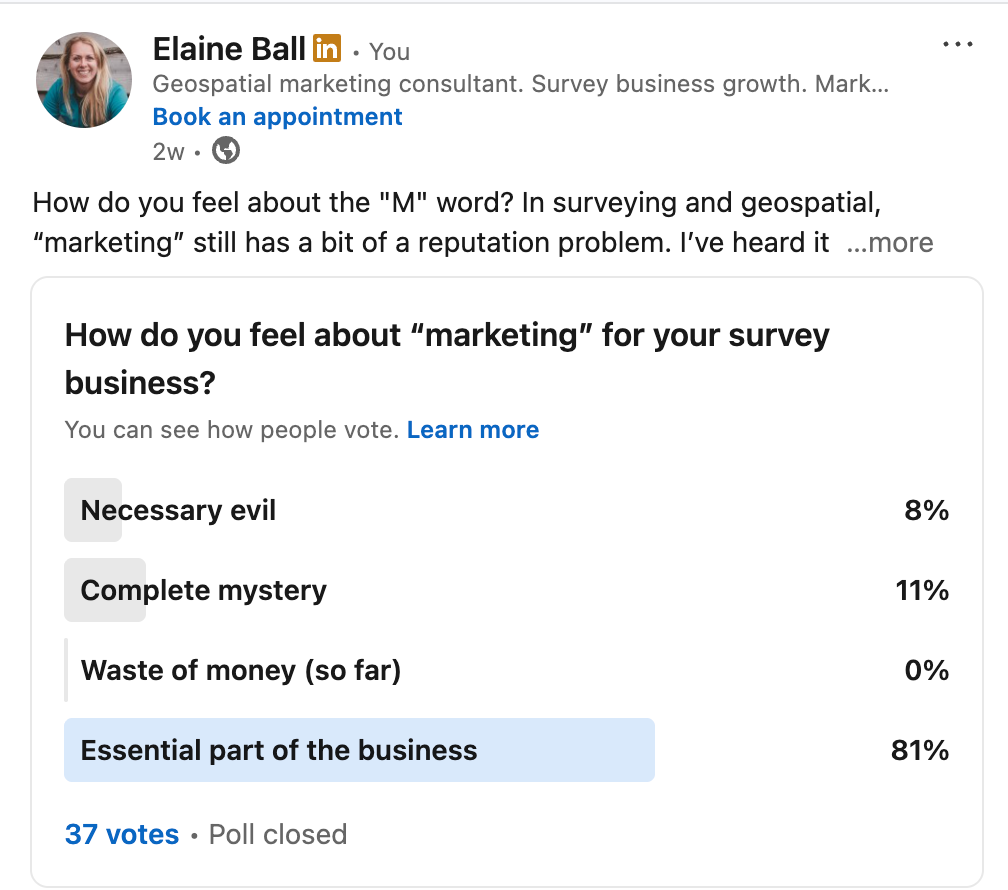
The cycle persists not because owners don’t know marketing matters – 77% of SME owners say they know it does (Pitney Bowes/CEBR). It persists because something underneath that knowledge quietly wins the argument every single time. Even a small poll on LinkedIn indicated the same pattern.
As the Success Academy research concluded:
“The feast-or-famine cycle isn’t a marketing problem. It’s a psychology problem.”
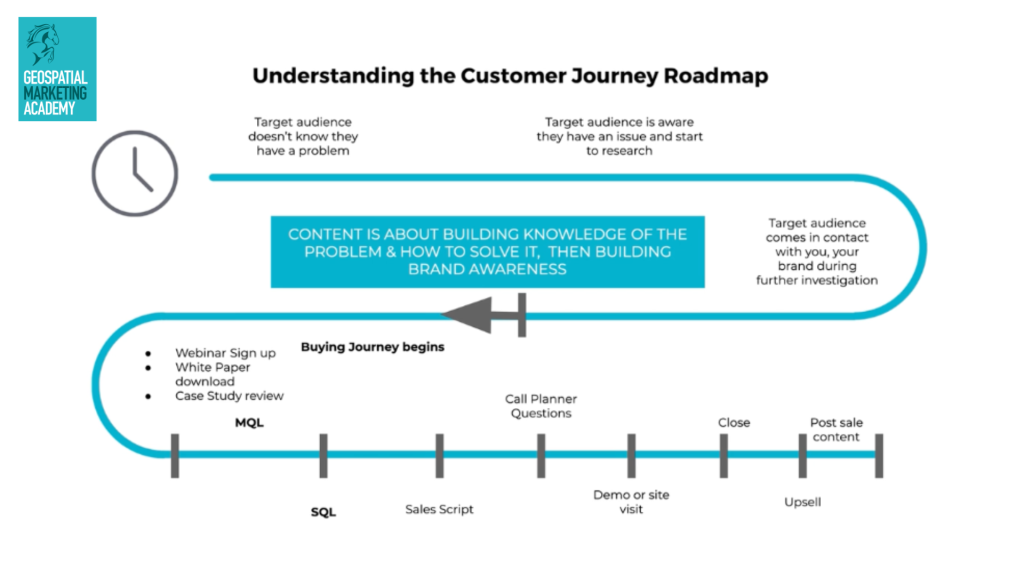
The cost: Firms miss better projects – monitoring contracts, hydrography work, rail, infrastructure programmes because they weren’t visible early enough in the buying process. Those projects go to whoever was already known and trusted when the specification was being written. Not to whoever was cheapest. Not to whoever sent the most desperate emails in January.
The impact: The feast-and-famine cycle doesn’t just cost you revenue. It costs you the type of revenue that builds a sustainable business. And for a meaningful proportion of firms, it eventually costs them the business itself.
4. Fixing It Later Is More Expensive
The mechanism: Ignoring marketing for years creates a compounding mess. When firms finally decide to “get professional help,” they discover the bill for retrospective fixes is eye-watering.
Typical UK/US marketing consultancy costs:
| Service | Cost Range (GBP) | Cost Range (USD) |
|---|---|---|
| Marketing consultant (hourly) | £100–£200/hr | $100-300/hr |
| Marketing strategy | £3,000–£10,000 | $5,500-15,000 |
| Brand repositioning | £10,000–£25,000+ | $15,000-40,000 |
| Website rebuild | £3,000–£15,000 | $5,000-20,000 |
| Full marketing rebuild (after years of neglect) | £20,000–£40,000 | $30,000-80,000 |
(Conservative figures)
And that’s before you add SEO remediation, case study development, CRM setup and content creation.
What consultants are actually fixing:
- Unclear positioning (“we do everything for everyone”)
- No buyer persona (you don’t know who you’re selling to)
- Weak or non-existent niche
- Confusing website that doesn’t convert
- Poor search visibility
- Inconsistent or non-existent content
- No lead generation system
- No proof of expertise (no case studies, no thought leadership, no visible track record)
The impact: Every year of neglect increases the eventual rebuild cost. Learning to do it right from the start is not a cost, it’s insurance against a much larger bill later.
5. AI Used Without Strategy
The mechanism: ChatGPT arrives. Every survey firm owner thinks marketing just got free. Copy-paste a prompt, generate a blog post, publish it. Job done.
Except it’s not. What you get is generic, over-polished content that sounds like every other AI-generated post on LinkedIn. No differentiation. No positioning. No insight that could only come from someone who’s actually done the work.
The scale of this problem is only getting worse. As of 2026, 95% of B2B marketers are now using AI tools (BizKonnect, 2026), which means generic AI output is everywhere.
You can see it
Decision-makers spot it instantly. A controlled experiment tracked 2,000 AI-generated articles across 20 domains over 16 months, the result: just 1,062 total clicks across all of them. The analysis was blunt: “Generative AI works on probability – it produces statistically average content. No one is going to bookmark, share, subscribe or revisit a site with average content.” (Sword and Script, 2026)
The differentiation crisis is already here. Contentifai’s 2025 research found that 71% of B2B marketers believe they communicate a distinct brand position – yet 68% of buyers say brands roughly act and sound the same (Dentsu, 2024). And 72% of senior marketers fear generative AI will make all thought leadership identical. Meanwhile, only 4% of B2B marketers have HIGH trust in generative AI outputs (CMI B2B Content Marketing Research, 2025).
As Contentifai (2025) put it: generic AI produces generic output. When you train it on your own knowledge, experience and way of working, it becomes much harder for competitors to copy. Used properly, AI amplifies what makes you different. Used badly, it just makes you sound like everyone else.
Or put more simply: AI can repeat what’s already been said, but it can’t come up with original thinking or real-world insight on its own.
The positive case is equally compelling but it cuts both ways. Edelman-LinkedIn research (2024) found that 75% of decision-makers say thought leadership has led them to research a product they weren’t previously considering and 23% subsequently awarded business to the organisation that produced it. 60% of global B2B decision-makers are willing to pay a premium for organisations that provide valuable thought leadership. But, and this is the critical part – 56% of buyers won’t work with a provider whose thought leadership is poor and 73% wouldn’t recommend them to colleagues.
For survey firms specifically, the geospatial sector is technically complex and relatively small. Buyers know the difference between genuine expertise and AI polish. A post that reads like a generic “What is LiDAR?” article doesn’t build trust, it quietly erodes it.
The reality:
- AI used with strategy = faster research, sharper idea generation, more efficient content production
- AI used without strategy = more noise, less differentiation, accelerated production of forgettable content
The impact: AI doesn’t replace the need for marketing knowledge. It amplifies whatever you already have. If you have a clear strategy, AI makes you faster. If you have no strategy, AI just helps you produce forgettable content at scale and in a small, specialist industry where buyers know their subject, that’s worse than saying nothing.
6. Visibility Decay (Missed Work)
The mechanism: This is the cost you never see because it’s the work that never arrives.
Firms are eliminated from consideration before they even know a project exists. No visible expertise. No educational content. No consistent presence. Not on the shortlist. Not in the conversation. Not even Googled.
The process:
- Client has a project need
- Client asks colleagues, checks LinkedIn, searches Google, asks ChatGPT, reviews industry directories
- Firms with visible expertise and consistent content get shortlisted
- Firms without it don’t and never find out
This isn’t a theoretical risk. It’s the documented reality of how B2B buyers now behave. MarketBetter’s 2026 dark funnel research found that 73% of the B2B buying journey now happens anonymously before a buyer ever contacts a vendor. 83% of buyers fully define their purchase requirements before speaking to anyone. And 94% of B2B buyers now use large language models during their buying process – meaning if your firm isn’t visible to Google, it may not even be visible to AI-assisted research either.
Traditional website analytics captures only 27% of the actual buyer journey. The other 73% happens in conversations, searches, social media, peer recommendations and AI tools that leave no trace. This is what researchers call the “dark funnel” and for survey firms relying on phone calls and referrals, it’s where most of the market has already moved.
Forrester (2025) is blunt about the implication: buyers start with an average of 5 to 8 vendors in mind and reduce to 3 or fewer before formal evaluation begins. Industry expertise ranked as the highest deciding factor – above pricing, cost structure and product fit. If you’re not on the initial list of 5 to 8, you don’t get the chance to demonstrate that expertise.
For survey firms this is especially acute. A utilities company scoping a pipeline survey doesn’t issue an RFP first. They ask colleagues, search LinkedIn, check Google. If your firm isn’t consistently visible in those channels, you never enter the conversation and you’ll never know what you missed. The business you’re losing doesn’t show up as a lost bid. It shows up as silence.
The impact: You can’t measure what you never knew about. But across an industry where projects are large, infrequent and often decided before the formal process begins, invisible firms are losing opportunities they’ll never even know existed.
7. Commodity Positioning
The mechanism: When buyers look at your website, your LinkedIn, your tender responses – what do they see?
For most survey firms, the answer is: “people with GNSS equipment, scanners, drones and total stations.”
That’s not positioning. That’s an equipment list.
When every firm looks identical, buyers have only one differentiator left: price.
This is the commodity trap, and it’s where the majority of the survey industry sits. As Beaton Research and Consulting – drawing on 20 years of professional services benchmarking – puts it directly: “Once a client starts to see you as interchangeable, you’re on a slippery slope, price becomes the only differentiator.”
The structural reason survey firms are especially vulnerable is substitutability – the academic term for how easy it is to swap one supplier for another. Insight2Profit research identifies substitutability as the single strongest predictor of price sensitivity. When buyers can easily switch between providers, price becomes the primary decision factor. Survey firms, with broadly similar credentials, equipment lists and ISO accreditation, look highly substitutable from the outside, even when they’re not.
The stakes are real. The Insight Collective (2025) found that 35% of B2B buyers examine 7–10 sources of information before making a purchase decision and 53% of decision-makers rely on case studies when assessing vendors. If your firm doesn’t have visible, credible, specific content such as case studies, technical articles, thought leadership pieces, you won’t make it through that research phase.
The market context makes this urgent. The global surveying and mapping services market is valued at $37.5 billion (2025), projected to reach $58.6 billion by 2032 (360iResearch). The broader engineering consulting market stands at $202.8 billion (Research Nester). This is a large, growing market but the firms that capture a disproportionate share of it won’t be the ones with the best scanners. They’ll be the ones buyers already trust when the project brief lands.
The evidence on specialisation is consistent and it comes directly from engineering and AEC firms.
Monograph’s March 2026 engineering fees benchmarking report – drawing on AEC industry data – found that small engineering firms billing under 250k achieve average net margins of just 9%, compared to 14.1% for firms above 5m. The gap isn’t explained by capability. It’s explained by fee discipline, pricing strategy and the absence of positioning that commands better rates. One 10-person engineering firm (Dynamic Engineering, Florida) reported 25% profit growth and 2x efficiency gains after gaining proper budget visibility and tightening their fee management. The same report notes: “Strategic advisory and rare expertise deserve value-based pricing. Defaulting to one model for everything leaves money on the table.” One engineering firm compared proposal rates against actual costs across 20 past projects, identified chronically underpriced services and achieved measurable margin gains without losing a single client.
RocLogic Marketing’s 2025 inbound marketing analysis for civil engineering firms found that inbound marketing (attracting customers with valuable, relevant content) – built around a clear niche, is currently ranked 5th among lead generation methods used by small and mid-sized civil engineering firms. That’s not a badge of honour. It means the vast majority are still relying on reactive, outbound methods like referrals, RFP responses, word of mouth, while the firms that have committed to niche content and inbound visibility are pulling away. Their niche opportunity analysis found geotechnical, water, transportation and structural engineering all rated as high-opportunity niches for firms willing to build visible expertise in them. Broad generalist positioning? Rated as the lowest opportunity, too easy to get lost in the noise.
The Cash Flow CFO (2025), working directly with engineering firms, documented a firm that identified its true labour burden, adjusted its pricing structure and increased its hourly billable rate by 15% – significantly improving profitability without losing a single client. Their finding mirrors everything in this document: “Many engineering firms underbid projects to remain competitive, only to find themselves struggling with low profit margins, tight cash flow and unsustainable growth. The key is not just securing more contracts but pricing them strategically.”
How to escape it:
- Choose a clear niche – be known for something specific: a sector, a specialism, a type of project
- Demonstrate expertise publicly – case studies, technical content, thought leadership that only you could write
- Maintain consistent visibility – show up regularly, not just when you need work
The impact: Specialists get shortlisted earlier, trusted faster and paid properly. Generalists compete on price. The difference between the two is not capability – it’s marketing. The scanner doesn’t differentiate you. The expertise, the sector knowledge, the reliability under pressure, those do. But only if buyers can see them.
The Compounding Effect
Surveyors understand accumulated error. A small miscalibration ignored long enough doesn’t stay small. These hidden costs work the same way. The table below is a conservative working estimate, built from the research above – of what five years of “we’ll sort the marketing later” actually costs a typical small survey firm.
| Hidden Cost | Annual Estimate | 5-Year Total |
|---|---|---|
| Billable time lost to unstructured marketing | 8,000–15,000 GBP/ 10,000-20,000 USD | 40,000–75,000 GBP/ 50,000-100,000 USD |
| Quiet underpricing / unnecessary discounting | 10,000–15,000 GBP/ 12,000-25,000 USD | 50,000–75,000 GBP/ 60,000-120,000 USD |
| Feast-and-famine revenue volatility | 5,000–10,000 GBP/ 7,000-25,000 USD | 25,000–50,000 GBP/ 40,000-80,000 USD |
| Future cost of fixing neglected marketing | 3,000–5,000 (deferred)/ 10,000-25,000 USD (when incurred, amortise 3-5k/yr) | 20,000–40,000 GBP/ 30,000-60,000 USD |
| Time spent creating content that looks good… but doesn’t win work | 2,000–3,000 GBP/ 3,000-7,5000 USD | 10,000–15,000 GBP/ 15,000-35,000 USD |
| Visibility decay (invisible lost revenue) | 5,000–10,000+/ 15,000-40,000 USD | £25,000–£50,000+ GBP/ 75,000-200,000 USD |
| Commodity positioning (price erosion) | 5,000–10,000 GBP/ 10,000-25,000 USD | 25,000–50,000 GBP/ 50,000-125,000 USD |
| Total estimated leakage | £30,000–£55,000+/yr | 150,000–275,000+ GBP/ 270,000-600,000+ USD |
These aren’t dramatic one-off losses. They’re slow, quiet, persistent and they add up to a quarter of a million pounds over five years for a firm that thinks it’s saving money by not investing in marketing.
And the numbers at sector level are just as sobering. Research by Pitney Bowes and the CEBR estimates that the SME sector is losing up to 122 billion in sales annually by allowing marketing to slip off the radar and that improved marketing could create 43 billion in value added for UK SMEs. That isn’t abstract. It reflects exactly the pattern survey firms repeat every year.
Surveyors understand compound error. A 5mm baseline error doesn’t matter at 10 metres. At 500 metres, it’s a serious problem. Marketing works the same way.
The Real Calculation GBP Example
Let’s take a typical solo survey firm turning over 150,000 per year and run the numbers honestly:
| Cost Category | Conservative Estimate |
|---|---|
| Billable time lost to ad hoc marketing (240 hrs × £50/hr) | £12,000 |
| Assuming typical discounting behaviour across projects (10%) | £15,000 |
| Stop-start pipeline (feast-and-famine revenue gap) | £5,000–£8,000 |
| Deferred marketing rebuild cost (amortised) | £4,000–£8,000 |
| Missed projects you were never even considered for | £5,000–£10,000 |
| Total annual hidden cost | £35,000–£55,000+ |
Even at the conservative end, most firms are quietly losing £20,000+ per year without realising it.
The Real Calculation USD Example
For a US version, a $200,000 solo firm is a reasonable parallel baseline and the cost lines below are anchored to current US consultant rates, small-business marketing budget norms and typical website/ strategy pricing.
How these USD figures were calculated
The US examples use a solo survey firm at roughly $200,000 annual revenue as a parallel to the £150,000 UK case. Annual hidden‑cost bands are scaled so they represent a similar share of revenue (around 30–38%), then checked against current US benchmarks for marketing consultant rates, typical small‑business marketing budgets (5–10% of revenue), and realistic pricing for strategy, branding and website projects. In other words, the dollar numbers are not currency conversions – they reflect what a comparable US firm would actually be leaking at today’s market rates, based on current guidance on marketing‑budget percentages, consultant pricing, and website redesign costs from Boomcycle Digital Marketing, Women Conquer Business, and StateWP.
Now compare that to the cost of actually learning how to do it properly.
The Geospatial Marketing Academy costs £5,995 GBP/ $8,000 USD (approx) That’s a one-time investment with lifetime access.
The question is not: “Can I afford marketing training?”
The question is: “Can I afford another year of £35,000–£55,000 in hidden losses? (or $57,000–$76,000 USD)”
That’s the real calculation. Not the cost of learning, the cost of not learning.
What Good Marketing Actually Gives You
Let’s be clear about what marketing is and what it isn’t.
Marketing is not self-promotion. It’s not bragging on LinkedIn. It’s not a glossy brochure no one reads.
Marketing is a commercial system that gives you control over:
- What work comes in – attracting the projects and clients you actually want
- What you say no to – having enough pipeline to be selective, not desperate
- How much you charge – positioning creates pricing power; visibility creates trust; trust reduces the need to discount
- How predictable your pipeline becomes – no more feast-and-famine; consistent visibility creates consistent enquiries
For survey firms, good marketing means:
- Being found when someone searches for your specialism
- Being trusted before the first conversation
- Being shortlisted based on expertise, not just price
- Having a content engine that works while you’re out on site
- Knowing exactly who your ideal client is and how to reach them
This isn’t fluffy. This is structural. And it’s learnable.
What Survey Firms Need to Learn
This is precisely why the Geospatial Marketing Academy (GMA) exists. It’s not a generic marketing course. It’s built specifically for this industry, by someone who’s spent years working inside it and watching the same mistakes repeated.
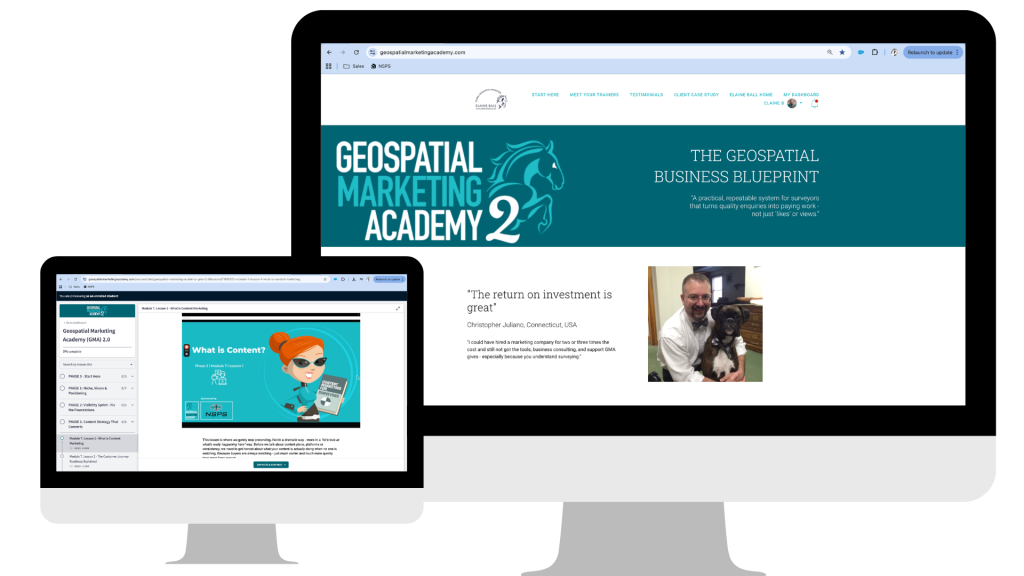
What the GMA covers
- Positioning and niche selection – how to stop looking like every other survey firm
- Buyer personas – understanding who actually makes the buying decision and what they care about
- Content strategy – what to create, where to publish it, and how to make it work without spending 20 hours a week
- Sales and marketing alignment – ending the war between “the people who win work” and “the people who do the work”
- Sales funnels – building a system that turns visibility into enquiries into revenue
- Pricing confidence – how marketing supports higher fees and reduces discounting
- Attracting the right customers – so you stop saying yes to projects that drain you
Programme structure
- Nine Phase online programme with lifetime access to all materials
- Designed for owners, directors, marketing managers and administrators in survey and geospatial companies
- Bonus modules from industry specialists:
- Tim Kitchen on SEO and online ranking
- Paul Reilly on Value Added Selling
- Charlie Whyman on LinkedIn strategy (5-day programme)
- Community access and bi-monthly live Zoom Q&A calls
The promise
Participants report seeing increased monetary results within 2 months of starting the programme. Not because of magic because of clarity. When you know who you’re targeting, what to say and where to say it, results come fast.
Learn more at www.geospatialmarketingacademy.com
The Uncomfortable Truth
Here’s the bit most people in this industry don’t want to hear.
Your technical skills are not enough.
They should be. In a fair world, the best surveyor would get the best work. But that’s not how buying decisions work in 2026. The firm that gets the best work is the one that’s visible, positioned and trusted before the buyer ever picks up the phone.
You wouldn’t set up a total station on two legs and hope for the best. Your business works the same way. Technical delivery, sales capability and marketing strategy – that’s the tripod. Remove one leg and the whole thing wobbles. Remove two and it falls over.
Most survey firms are operating on one leg.
The hidden costs laid out in this document aren’t theoretical. They’re happening right now, in your business, every week. The question is whether you’re going to keep paying them or whether you’re going to learn the skills that make them stop.
Marketing isn’t an expense. It’s the difference between running a business and just doing a job.
Stop leaking money. Start learning.
Elaine Ball is the founder of the Geospatial Marketing Academy, the only marketing training programme built specifically for survey and geospatial companies. She has spent years inside the industry watching talented firms undercharge, undersell, and underperform – not because of their technical work, but because of their commercial visibility.
This document is based on the LinkedIn article “The Hidden Costs of DIY Marketing in Your Survey Firm” (March 2026) and training content from the GMA programme.
© 2026 Elaine Ball / Geospatial Marketing Academy. All rights reserved.
Sources and Further Reading
Why Survey Firms Underinvest
- Forrester: B2B Buyers Choose Vendors Before Buying Process Begins https://www.digitalcommerce360.com/2025/07/07/forrester-b2b-buyers-choose-vendors-before-the-buying-process-begins/
- Gartner / Boomcycle: Average Marketing Budget Benchmarks https://boomcycle.com/blog/right-percentage-of-gross-revenue-to-invest-in-marketing/
- Pitney Bowes / CEBR: Small Businesses Neglecting Marketing https://smallbusiness.co.uk/small-businesses-neglecting-marketing-finds-research-2249743/
Hidden Cost #1 – Billable Time
- Forbes / Constant Contact: Small Business Marketing Challenges 2024 https://www.forbes.com/sites/allbusiness/2024/04/30/a-2024-report-reveals-small-business-marketing-challenges/
- AiR Digital: How Much Time Should Small Businesses Spend on Marketing https://airdigital.io/how-much-time-should-small-businesses-spend-on-marketing/
- Speakwise / APA: Context Switching Statistics https://speakwiseapp.com/blog/context-switching-statistics
- BasicOps: The Hidden Cost of Context Switching https://www.basicops.com/cb-articles/the-hidden-cost-of-context-switching-cc4za
Hidden Cost #2 – Quiet Underpricing
- Pricefx: Psychology of Pricing in B2B https://www.pricefx.com/learning-center/the-psychology-of-pricing-in-b2b-2024s-profitable-tactics
- Fabi Paolini: Charging Less Doesn’t Help You Sell More https://www.linkedin.com/posts/fabipaolini_charging-less-doesnt-help-you-sell-more-activity-7373407769351303168-0Mqm
- Robert Collings: Value Over Price – How B2B Buyers Actually Make Decisions https://robertcollings.com/value-over-price-how-b2b-buyers-actually-make-decisions/
- Deloitte: Brand Trust and Willingness to Pay Premium https://www.linkedin.com/posts/abdulwasaywaraich_brandstrategy-marketingroi-customertrust-activity-7382381147164512256-JweO
- McKinsey / Monetizely: Pricing Psychology and Profit Impact https://www.getmonetizely.com/articles/the-pricing-psychology-expertise-professional-level-customer-behavior-analysis
- Beaton Research: Clients Will Pay More for Excellent Experience https://beatonglobal.com/clients-will-pay-more-for-excellent-client-experience/
- Bain & Company: Is Pricing Killing Your Profits https://www.bain.com/insights/is-pricing-killing-your-profits/
- Insight2Profit: Price Sensitivity Research https://www.insight2profit.com/price-sensitivity-what-it-is-how-to-measure-it-and-the-ways-price-impacts-buying-behavior/
- HBR Pricing Study Revisited: 1% Price = 6.4% Profit https://www.linkedin.com/posts/arminkakas_hbr-pricing-study-revisited-how-much-profit-activity-7325139130386890754-Se6a
Hidden Cost #3 – Feast and Famine
- Dreamdata: B2B Marketing Time Lag (192 days) https://dreamdata.io/blog/testing-the-b2b-marketing-time-lag
- Equinet Media / Dentsu: B2B Long Sales Cycles (379 days for technical services) https://www.equinetmedia.com/blog/b2b-long-sales-cycles
- Focus Digital: Average Sales Cycle by Industry (134 days construction) https://focus-digital.co/average-sales-cycle-length-by-industry/
- Treefrog: The Cost of Delay in Marketing https://www.linkedin.com/posts/treefrog_the-cost-of-delay-is-one-of-the-most-overlooked-activity-7435006416802975746-yTAB
- MGO CPA: Cash Flow Strategies for A&E Firms https://www.mgocpa.com/perspective/cash-flow-strategies-architecture-engineering-firms/
- Monograph: Financial KPIs for A&E Firms 2026 https://monograph.com/blog/financial-kpis-architecture-engineering-firms-2026
- Success Academy UK: The Feast-or-Famine Cycle https://thesuccessacademy.co.uk/the-feast-or-famine-cycle-why-uk-consultants-get-stuck-and-how-to-break-fbusy-december-dead-january-ree/
- Relay Cash Flow Compass 2024 https://www.prnewswire.com/news-releases/new-relay-cash-flow-compass-uncovers-small-businesses-are-42-overconfident-in-their-cash-flow-control-302222383.html
- JPMorgan Chase Institute: Facing Uncertainty https://www.jpmorganchase.com/content/dam/jpmc/jpmorgan-chase-and-co/institute/pdf/institute-facing-uncertainty.pdf
- MIT Sloan Management Review: Taming the Volatile Sales Cycle https://sloanreview.mit.edu/article/taming-the-volatile-sales-cycle/
- Deltek: Revenue Leakage in Professional Services https://www.deltek.com/en/blog/revenue-leakage-in-professional-services
- Predictable Profits: Feast or Famine Revenue Swings https://predictableprofits.com/feast-or-famine-cycle-revenue-swings/
- Harvard / Kegan & Lahey: Immunity to Change Research https://www.gse.harvard.edu/hgse100/story/changing-better
Hidden Cost #4 – Fixing It Later
- Growth Partners: High Cost of Poor Marketing for SMEs https://growthpartners.org/the-high-cost-of-poor-marketing-strategies-for-smes-navigating-financial-risk-and-customer-growth/
- TMarketing: Hidden Costs of Running Without a Strategic Marketing Plan https://tmarketing.com.au/the-hidden-costs-of-running-an-sme-without-a-strategic-marketing-plan-5/
- T40 UK: Rebrand Case Study (47% sales increase) https://t40uk.com/rebrand-case-study
- The Visible Authority: Consultancy Repositioning Case Study https://www.thevisibleauthority.com/blog/how-this-consultancy-cut-back-30-percent-of-its-services-yet-improved-profitability
- LinkedIn / Susan Gold: Top Marketing Strategy Mistakes in B2B Professional Services https://www.linkedin.com/pulse/top-marketing-strategy-mistakes-b2b-professional-services-susan-gold-3pcve
Hidden Cost #5 – AI Without Strategy
- Sword and Script: AI Generated Content Experiment (2,000 articles, 16 months) https://www.swordandthescript.com/2026/03/ai-generated-content/
- Contentifai: The B2B Content Differentiation Crisis https://www.contentifai.agency/the-b2b-content-differentiation-crisis-why-most-b2b-brands-sound-the-same/
- CMI: B2B Content Marketing Research 2025 https://contentmarketinginstitute.com/b2b-research/b2b-content-marketing-trends-research-2025
- BizKonnect: Why Generic AI Prompts Are Failing B2B Content Strategy https://www.bizkonnect.com/blogs/why-are-generic-ai-prompts-failing-your-b2b-content-strategy
- Altitude Marketing: What B2B Marketers Need to Know About Using AI in Content https://altitudemarketing.com/blog/what-b2b-marketers-need-to-know-when-using-generative-ai-in-content/
- Marketing Agent Blog: Brand Authenticity and AI https://marketingagent.blog/2025/11/08/brand-authenticity-concerns-how-ai-transforms-brand-consumer-relationships-and-trust/
Hidden Cost #6 – Visibility Decay
- MarketBetter: B2B Dark Funnel Research 2026 https://marketbetter.ai/blog/b2b-dark-funnel-capture-invisible-buyers-2026/
- Sword and Script: AI Short List Research https://www.swordandthescript.com/2026/01/ai-short-list/
- GrowthSpree: Dark Funnel B2B https://www.growthspreeofficial.com/blogs/dark-funnel-b2b-saas-70-percent-pipeline-invisible-how-to-measure
- B2B Marketing Brief: The Measurement Reckoning https://www.b2bmarketingbrief.com/p/the-measurement-reckoning
- SalesTech Star: Illuminating the Dark Funnel https://salestechstar.com/staff-writers/illuminating-the-dark-funnel-tech-to-track-the-invisible-b2b-buyer/
Hidden Cost #7 – Commodity Positioning
- 360iResearch: Surveying and Mapping Services Market Size 2025–2032 https://www.360iresearch.com/library/intelligence/surveying-mapping-services
- Research Nester: Engineering Consulting Services Market https://www.researchnester.com/reports/engineering-consulting-services-market/8320
- Grand View Research: AEC Services Market https://www.grandviewresearch.com/industry-analysis/architectural-engineering-construction-services-market-report
- Monograph: Engineering Fees and Pricing Models 2026 https://monograph.com/blog/engineering-fees-pricing-models-best-practices
- RocLogic Marketing: Inbound Marketing for Civil Engineering Firms https://roclogicmarketing.com/lead-focused-inbound-marketing-for-civil-engineering-firms/
- The Cash Flow CFO: Profitability in Engineering – Stop Underbidding https://thecashflowcfo.com/profitability-in-engineering-stop-underbidding/
Compounding Effect
Pitney Bowes / CEBR: UK SMEs Losing £122 Billion Annually Through Marketing Neglect https://smallbusiness.co.uk/small-businesses-neglecting-marketing-finds-research-2249743/