
Part of the Geospatial Growth Series
Let me take you back to the early days of my career in the geospatial industry.
I’m at my desk at MDL (Measurement Devices Ltd) and I’ve got a stack of trade magazines in front of me. GIM International. Survey Review. The kind of publications that landed on desks with a satisfying thump and smelled faintly of ink and ambition.
Back in the 90s, these were the publications we advertised in. I’d flick through them page by page, looking at the latest instruments, software and suppliers, knowing our own adverts were sitting in those same pages being seen by surveyors and engineers across the world.
Then, a few days later, the postman would arrive carrying a BIG BAG of cards. Enquiry cards from people sitting in offices just like ours, flipping through the magazine, spotting our advert and tearing out the reply card at the back to request more information.
That was the pipeline.
That was the funnel.
That was marketing.
No automation. No dashboards. Just good adverts, good publications, and a postman doing overtime. Proper job.
Fast forward to 2026.
That pipeline still exists in geospatial firms, it’s just running in people’s heads instead of through the post.
This month, we’re going deep on the most misunderstood (and feared) word in the Geospatial business vocabulary: marketing.
What it actually is, where it came from, how it evolved and – critically – why the average survey firm is operating with a marketing mindset that’s roughly fifteen years out of date (and the rest).
At the end of the article, I’ve included my top 10 key insights to take away with you.
So, What Actually Is Marketing?
To find out where my community of fab surveyors, geospatial pros and equipment sellers’ heads are at when it comes to understanding what marketing really is, I asked my LinkedIn network a question…
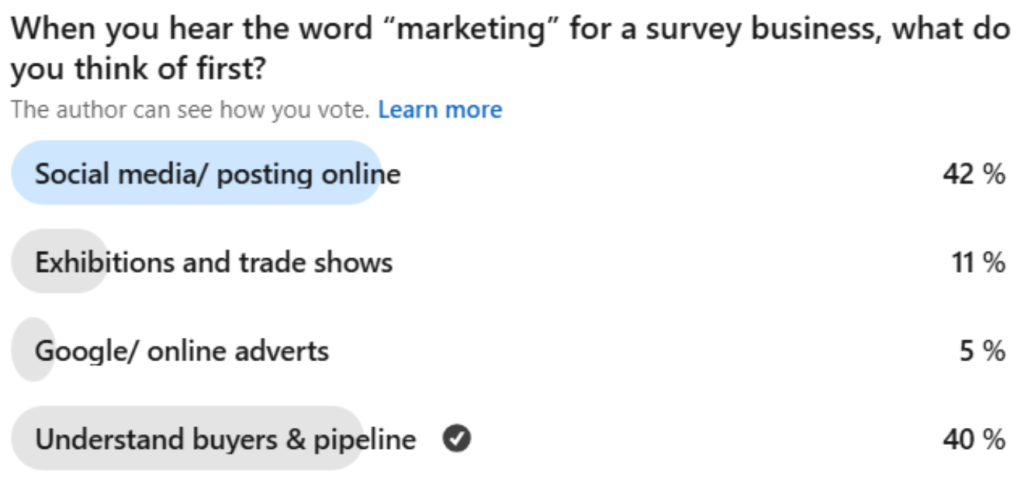
The results showed that 42% of surveying professionals first think of social media and posting online.
You can’t blame them, that’s what they’ve been consistently told to do – and what everybody else is doing. But the reality is that marketing is SO much more than that.
In fact, social media and posting online are just the outcome of genuinely effective marketing.
Here’s the official definition, courtesy of the American Marketing Association:
“Marketing is the activity, set of institutions, and processes for creating, communicating, delivering, and exchanging offerings that have value for customers, clients, partners, and society at large.”
Not exactly a page-turner, is it? Let’s try a better version…
Marketing is everything a business does to make the right people aware that it exists, understand what it does, trust that it does it well and ultimately choose it over the competition.
Notice what’s not in that definition? Social media. Influencers. Posting on LinkedIn three times a week. Those are tactics. Marketing is the strategy that gives those tactics a reason to exist.
Philip Kotler, widely regarded as the father of modern marketing, describes the evolution of the discipline as a journey from pure functionality to something far more sophisticated. In the early days, marketing simply communicated what a product did. Then it moved to how it made you feel. Then to what values it stood for. And finally, where we are now, to how it creates genuine, measurable value for the people it serves.
Marketing isn’t just advertising or social media. It never has been. And if you’ve been treating it that way, that’s costing you the big bucks.
A Brief, Genuinely Interesting History of Marketing
The Trade Press Era (1800s–1960s): When the Postman Was the Pipeline
In the early 1800s, the first trade journals appeared. The American Railroad Journal, launched in 1831, was one of the first publications to carry B2B advertising, reaching iron manufacturers, miners and engineers with targeted commercial messages. In 1895, John Deere launched The Furrow, a magazine not designed to sell tractors, but to educate farmers on better crop management. It’s widely cited as the first true example of content marketing. It is, rather wonderfully, still published today.
In 1895, the idea was radical: give your customers valuable information for free, and trust that the business follows. Sound familiar? It should. That’s still the model that works best in 2026.
The 4Ps of Marketing – Product, Price, Place, Promotion – were formalised by E. Jerome McCarthy in 1960 and popularised by our old pal Kotler soon after. For the first time, marketing had a structured framework. It was a product-focused era, and it worked because the market was growing and competition was limited.
Then came the trade press golden age. For geospatial and survey businesses, this era extended well into the 1980s and 1990s. If you wanted to reach surveyors, you advertised in industry magazines. You exhibited at trade shows. You sent direct mail. The lovely postman brought the enquiries.
Professional Services Wake Up (Late 1980s–1990s): Marketing Finds Its Boots
Here’s something fascinating: professional service firms like accountants, lawyers, architects, and yes, surveyors, were legally or culturally prohibited from marketing themselves for much of the 20th century.
The US Supreme Court’s landmark 1977 Bates decision opened the door for law firms to advertise for the first time. In the UK, the 1986 deregulation of the City of London, the so-called “Big Bang”, triggered a wave of mergers and suddenly made brand differentiation essential for the first time. Accountancy firms like Deloitte, KPMG and PwC built sizeable marketing teams throughout the 1990s. Law firms followed.
The professional services marketing industry as we know it today is barely 40 years old.
Surveyors and geospatial firms? They were, broadly speaking, watching from the sidelines. The technical mindset prevailed: if the work is good, the work speaks for itself.
And for a while, it did.
The Internet Changes Everything (2000s): The Buyer Grabs the Wheel
Around the turn of the millennium, something fundamental shifted in B2B buying behaviour. Buyers could now research vendors online before ever picking up the phone. Websites became essential. Email transformed communication. Google arrived and rewrote the rules of who gets found and who gets ignored.
By the mid-2000s, B2B marketing had pivoted from product-centric to customer-centric.
Content marketing, the art of giving away genuinely useful information to build authority and trust, moved from the margins to the mainstream. The inbound philosophy, championed by HubSpot from 2006 onwards, taught businesses to attract buyers rather than interrupt them.
The 4Ps model, designed for a world of physical products, got extended into the 7Ps, adding People, Process, and Physical Evidence, specifically to accommodate the service-based businesses that the original model couldn’t capture. For a firm that sells expertise and relationships rather than physical goods, that distinction matters enormously.
The Content & Data Era (2010–Present): Now It’s a System
The 2010s brought us content marketing at scale, account-based marketing and data-driven decision-making. LinkedIn became the single most powerful B2B marketing channel on the planet. B2B buyers began completing their research before ever contacting a salesperson. Today, 70-80% of the buying journey happens before ever contacting the company. Yes – I said 70-80%.
By the time a potential client picks up the phone to call your firm, they may already have a preferred vendor in mind. They’ve Googled you. They’ve read whatever content you have (or haven’t) published. They’ve formed an opinion. Your marketing was either working for you in those moments or it wasn’t.
Right now, 70% of B2B buyers say content quality directly influences their final purchase decision. And B2B buyers review, on average, 11 pieces of content before contacting a vendor.
Where Are Survey Businesses in This Timeline?
Here’s the honest answer: most are still operating with a 2010 mindset. Some are operating with a 1995 mindset and don’t even know it.
(P.S. follow me on LinkedIn to stay up-to-date on the current changes and advancements in the marketing landscape – specifically for Geospatialers!!)
The Marketing Maturity Gap Is Real
A major 2024 survey of nearly 2,000 UK SME decision-makers found that 67% of businesses have no documented marketing action plan. Only 44% use specialist marketing services, and of those, barely 62% say those services deliver good value for money.
The engineering and agriculture sectors ranked among the worst performers for overall marketing health. Surveyors are a subset of those engineering-adjacent technical businesses. The pattern is the same everywhere: brilliant technical output, serious commercial blind spots.
The Referral Trap
Word-of-mouth and referrals are genuinely powerful. 93% of B2B buyers trust word-of-mouth over other forms of advertising. Referrals account for 65% of new business opportunities for most firms. It’s no wonder that 85% of small businesses rely primarily on word-of-mouth to attract new clients.
That’s not a criticism of referrals. They are a signal that you’re doing excellent work. Well done!!!
But here’s what the data also shows: 52% of small businesses say referrals are their top source of new business, which means they’ve built no other muscle. They’ve outsourced their pipeline to other people’s conversations.
When the referrals slow, and they always slow eventually, there is nothing left. No content, no visibility, no credibility outside the existing network. No marketing. No postman. Just waiting.
What’s Changed – And Why It Matters to You
Here’s the headline timeline of how marketing has evolved and why it matters if you’re running a survey business right now.
| Era | What “Marketing” Meant | Typical Survey Firm Approach |
| Pre-1960s | Trade press ads, catalogues, direct mail | Some trade advertising |
| 1960s–1980s | Brand awareness, 4Ps, sales support | Rarely used; reputation-led |
| Late 1980s–1990s | Professional services start marketing | Still largely absent |
| 2000s | Digital channels, SEO, email, early content | Slow adoption; website as brochure |
| 2010–2020 | Content marketing, inbound, social media, LinkedIn | Basic LinkedIn presence; some try-and-fail with agencies |
| 2020–present | Data-driven, full-funnel, authority-building, AI-assisted | Mostly stuck here or earlier |
The gap is not a small one. The geospatial industry is technically world-class, drone surveying, LiDAR, AI-assisted data processing – all cutting-edge. The global geospatial analytics market is projected to reach USD 186 billion by 2032, growing at 13.6% per year.
The opportunity is enormous.
But the commercial capability to capture that opportunity? That’s often stuck in 2010. Or (gasp) even 1995.
The Cost of Being 15 Years Behind
The average B2B business today invests around 8% of annual revenue in marketing. In professional services, that rises depending on growth ambitions. Firms that invest strategically and build long-term brand authority consistently outperform those that don’t.
And yet the typical survey firm spends far less, closer to the 3-5% range (if that) seen in architecture and engineering firms, and much of that in reactive proposal activity rather than proactive brand-building.
Get an in-depth drill-down into this in my article ‘Hidden Costs: When Survey Companies Don’t Understand Marketing and Sales’.
But the cost isn’t just the money spent. It’s the business not won. It’s the clients who found your competitor on Google because you weren’t there. It’s the work you quoted for and lost because the other firm looked more credible online. It’s the potential clients who formed an opinion of your business before you even knew they existed.
Because 90% of B2B buyers use online channels as their primary method of identifying new suppliers – and you’re either there or you’re not.
How much is DIY marketing really costing you? Free webinar replay and calculator
Timothy Burch (NSPS Executive Director) and I ran a live webinar, “The Hidden Cost of DIY Marketing in Your Survey Firm”, where we examined: why survey firms chronically underinvest in marketing, the major “hidden cost” buckets and real‑world numbers showing how annual lost margin compounds if nothing changes.
The Opportunity (For The Firms That Get It)
The great thing about the gap between where most survey businesses are commercially and where they could be is that if you choose to get started now, you’re at an advantage.
If you’re one of the few geospatial firms in your market who…
- Shows up consistently with authoritative, genuinely useful content
- Has clear positioning
- Builds a credible online presence
- Has a system for turning visibility into actual pipeline
… then you’ll be the obvious winner before most of your competitors even knew there was a race.
The surveying and mapping market is growing at around 7.4% per year. The firms that will capture the lion’s share of that growth are not necessarily the most technically sophisticated. They’re the ones who will learn to be as good at growing their businesses as they are at delivering the work.
According to a peer-reviewed study of over 500 technical entrepreneurs, the single strongest predictor of business survival is not technical expertise, it’s self-efficacy in sales and marketing. The firms that close the commercial capability gap don’t just grow faster. They survive when the referrals dry up.
The Bottom Line
Marketing is not social media. It’s not posting. It’s not paying an agency to produce content you don’t understand for an audience they don’t know.
Marketing is the system that ensures the right people know you exist, understand what you do, trust that you do it brilliantly, and choose you. It has been evolving for well over a century.
And for most of that time, the firms that took it seriously, from John Deere in 1895 to the professional services firms who woke up in the 1990s, grew faster, more profitably and more sustainably than those who relied on reputation alone.
The geospatial industry is at a crossroads. The market is growing. The technology is extraordinary. The commercial capability, for most firms, is lagging.
You should no longer be asking whether marketing works. Now is the time to start taking it seriously before the referrals slow down.
From 2010 to 2026: What Taking Your Marketing Forward Actually Looks Like
I’m not trying to convince you to become a different kind of business. It’s all about adding the commercial layer that your technical excellence deserves.
Start with strategy, not tactics.
Before you spend a penny on ads, content, or agencies, get clear on who you’re trying to reach, what you want them to think, and what action you want them to take.
Build your authority through content.
Regular, genuinely useful content like blogs, LinkedIn posts, webinars and case studies, to build the kind of credibility that no advert can buy. John Deere figured this out in 1895. It still works.
Treat your marketing like a system.
What gets measured gets managed. What gets managed gets better.
Understand the full funnel.
Not just “are we getting enquiries?” but: how are potential clients finding us, what are they reading, what makes them reach out, and what makes them choose us?
Stop waiting for the referrals to do all the work.
They’re great when they arrive. But they’re not a pipeline. They’re a bonus.
Geospatial Businesses Marketing FAQs
Q: What is marketing for a survey business?
Marketing for a survey business is the process of building trust, educating potential clients and attracting the right enquiries before a prospect needs your services.
Q: Why do survey businesses struggle with marketing?
Many survey businesses rely on referrals, inconsistent activity or outdated tactics instead of following a clear marketing strategy.
Q: Is marketing just social media?
No. Social media is only one marketing channel. Marketing includes positioning, messaging, websites, SEO, email, networking and building trust.
Ready to take your survey business marketing from 2010 to 2026?
The Geospatial Marketing Academy is built specifically for technical professionals who are brilliant at their craft, and ready to become brilliant at growing the business too.
Missed last month’s piece? Take a look:
Ten Marketing Takeaways to Learn Right Now
- Marketing is a system, not a series of random activities. Random posts, occasional ads, a website that hasn’t been updated since 2018 – that’s not marketing. That’s noise.
- Your buyers are researching you right now, without you knowing. 84% of B2B buyers start their process with a referral from a peer, but then they go online to verify. Are you easy to find? Credible? Authoritative?
- Content marketing is not new, it’s just new to you. John Deere was doing it in 1895. The principle hasn’t changed: educate your market, and the business follows.
- Social media is a tactic, not a strategy. It’s one channel, among many. The mistake most small businesses make is treating it as the whole thing, and then wondering (or complaining to me about) why it doesn’t work.
- Word-of-mouth is not a marketing strategy. It’s a result of good work. You still need to be discoverable, credible and top-of-mind for the clients who haven’t been referred to you yet.
- The 4Ps were designed for product companies in 1960. If you sell expertise and relationships, (hint – you do) you need the 7Ps: Product, Price, Place, Promotion, People, Process and Physical Evidence. That last P? In geospatial services, it’s your case studies, your credentials, your client testimonials. The tangible proof of intangible expertise.
- B2B buyers are 70-80% through their decision-making before they contact you. If you’re not visible during that research phase, you don’t exist.
- The firms with the best marketing are not necessarily the best at the technical work. This is uncomfortable, but it’s true. Marketing creates the perception of credibility. Credibility wins the work. The work earns the reputation. But without the marketing, none of it starts.
- Not knowing what marketing is, costs real money. £1,000 on Google Ads. £2,000 a month to an agency who promised the world and delivered vanity metrics. Hours of LinkedIn posting with no strategy. These aren’t marketing failures, they’re the result of not understanding what marketing actually is and what it’s supposed to do. That’s exactly where the hidden costs begin.
The answer is not more tactics. It’s a system. Strategy first, then execution. Big picture and the detail, not one or the other.